🇬🇧 English
🇫🇷 Français
For coaches

Adding your next client shouldn't cost you another Sunday.

Right now it does. That's not your ability — it's five hours a week of programme edits, chased check-ins and nutrition maths done by hand.

Start free trial — no card
7 days free · No card required · Your clients onboard themselves
Create account
Sign in
Full Name
Email
Password
Full access. Nothing locked. No commitment until your trial ends.
7 days free. No card required, cancel anytime.

You know the exact shape of it.

Desk by ten. Cold coffee. A wall of client logs.
One client moved from a barbell squat to a goblet squat, so now you open week two, edit it, save. Week three, edit, save. Week four. Six weeks for one substitution.
Then the nutrition. The sync broke again, so you open each client's app individually and work out their weekly averages on a calculator.
By four in the afternoon your brain is finished and you haven't done anything a client would call coaching.
Through the week it's another two or three hours — chasing the ones who haven't logged, answering the ones standing in a busy gym asking what to do instead of the squat rack.

Six or seven hours. Every week. None of it billable. None of it why you became a coach.

That's not a limit. That's admin.

Every coach has a number where it stops being manageable.

Yours might be eight. It might be twenty-five. Wherever it sits, you can feel it coming — the point where check-in videos get shorter, programming gets generic, and the service you're proud of starts sliding.

So you slow down. You stop pushing for the next client, or you take them and quietly absorb the hit.

Here's what's actually happening.

Every client you add brings a fixed block of unpaid work with them. A programme to write. Progressions to edit by hand. Check-ins to chase. Nutrition to average manually. Equipment substitutions to re-sequence.

Coaching scales. That doesn't.

Your limit isn't how many people you can coach. It's how many you can administrate.

And your platform is building the wall.

You've probably tried to fix this already. Two years on Trainerize. Priced out HubFit, Everfit, TrueCoach. Maybe switched once.

They're not all bad. But every one of them sells you client management — and client management isn't the thing eating your week.

Trainerize is where most coaches start and where most of this frustration lives. Coaches report tier costs that climb as they grow, add-ons for things that should be included — including a monthly fee to connect their own payment processor — and a client app their clients complain about.

HubFit is the newer one, and it's broad. Training, nutrition, habits, check-ins, a library. You still can't take a payment without upgrading a tier.

But breadth was never the problem. None of them is short of features.

Every platform in this category automates delivery — sending the programme, scheduling the message, storing the video.

None of them automates the thinking: the progression maths after each session, the substitution when the equipment isn't there, the nutrition recalculated when the week changes, the flag when a client's data says back off.

That's the part that grows with every client you add. That's what's still on you at ten past four on a Sunday.

All-in-one. And the one thing eating your week isn't in it.

In practice it looks like this.

Changing one exercise means editing every workout by hand
No sequence edit, no propagate-forward. Twelve manual saves for one substitution.
Nutrition breaks and the maths becomes yours
An integration desyncs, and you're opening each client's app with a calculator.
You're paying for a feature set built for a different coach
Habit libraries, challenge leaderboards, booking modules — a Swiss Army knife when the thing eating your week is one job.
And your clients can't use it properly
Squat rack is busy on a Tuesday evening, the app won't let them swap the exercise or log an unscheduled session, so they text you. Their software limitation becomes your interrupted evening.

Your platform isn't reducing your admin. It's generating it.

So what actually moves the ceiling.

Not a cheaper platform. Not a faster programme builder.

The repetitive work has to stop existing.

The progression maths. The manual substitutions. The nutrition averages. The chasing. The questions clients ask because their app can't answer them.

Take that away and the ceiling moves on its own. Same coach, same hours, more clients — or the same clients and your Sunday back.

Which brings up the thing you're already thinking.

The AI drafts. You approve. No programme reaches a client without you.

Let's deal with this properly, because it's the actual question.

Generating a programme and selling it as custom coaching is dishonest. We agree. If a client is paying you CHF 200 a month and an algorithm is doing the thinking unsupervised, that's not coaching — and you'd be right to want no part of it.

That's not how FORGE works, and the difference is structural rather than a promise.
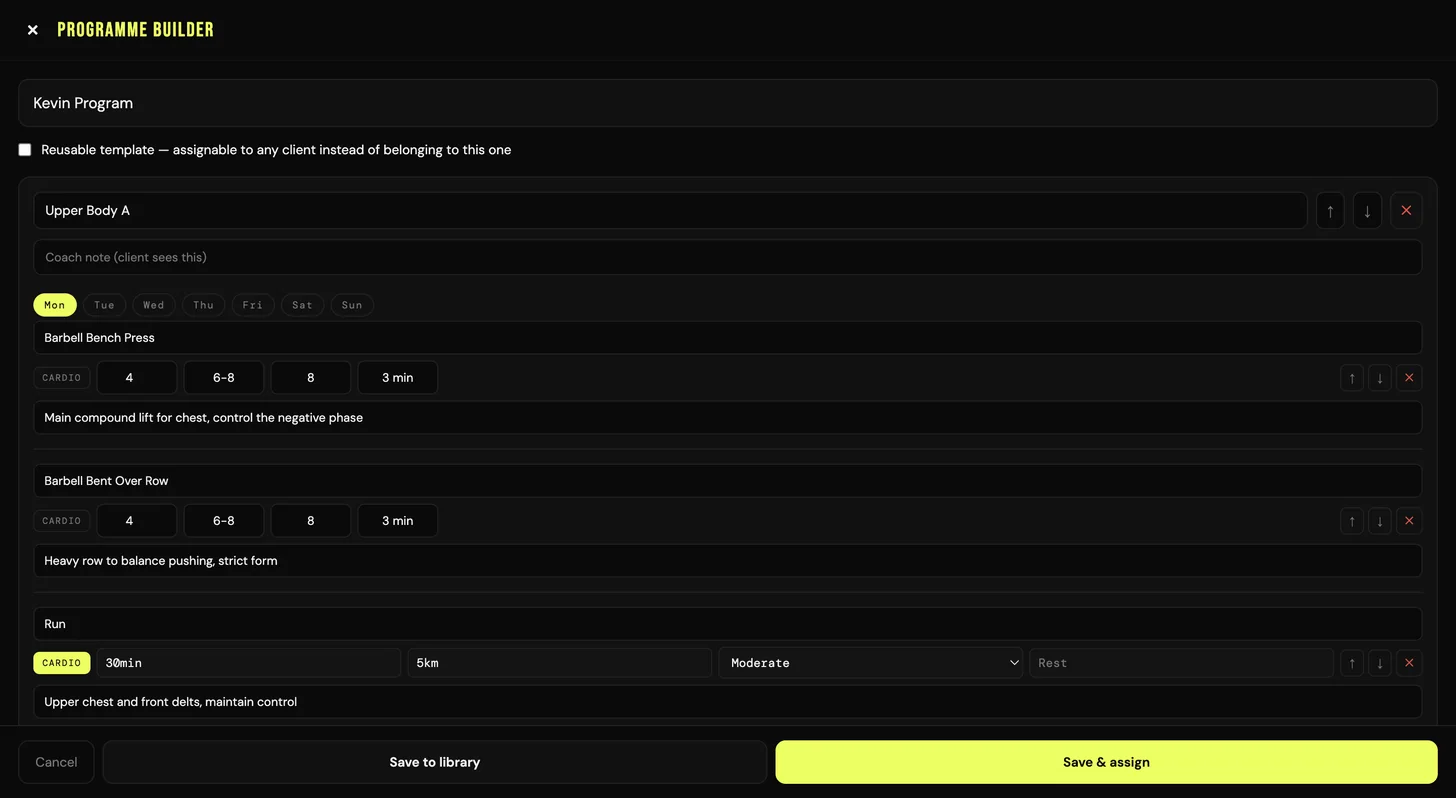
The AI produces a draft. It lands on your dashboard. It goes nowhere else.
The FORGE programme builder open on a training week, with editable exercises, sets, reps, rest and coach notes, and Save to library and Save and assign buttons along the bottom.

You review it. You edit it. You approve it. Only then does your client see anything.

There is no path from a generated programme to your client that doesn't pass through you. The generator writes nothing — no plan saved, no notification sent — until you save it yourself. That isn't a setting you could leave switched on. It's how the builder is wired.
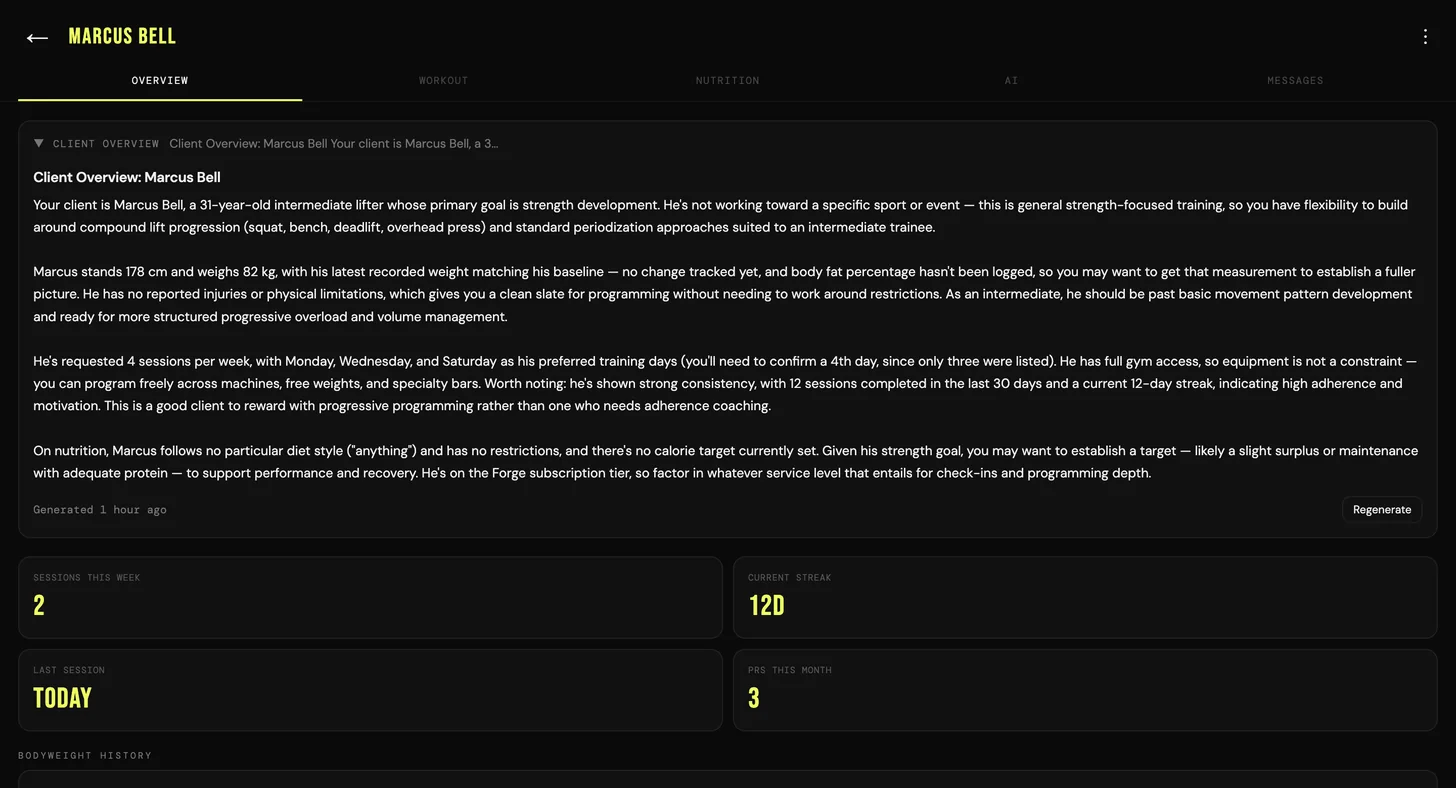
A client overview in FORGE, showing an AI-written summary of the client alongside sessions this week, current streak, last session and personal records this month.

Your client's own AI coach is a separate thing, and it does speak to them directly — check-ins after a session, weekly and monthly reviews. That's the part they're paying for. You can switch any of it off, per client, from their card.

What the AI is doing for you is the arithmetic — periodisation maths, progression logic, volume tracking, equipment substitutions, flagging the client who has quietly stopped logging. The part of your week that's data entry.

What stays yours is everything you actually charge for. Exercise selection judgement. Knowing which client needs pushing and which needs backing off. The relationship. The accountability. The reason they picked you.

A machine can do the arithmetic. It cannot do that.
What your week looks like instead.

Drafts built from the client, not from a blank page
The builder reads their goal, equipment, injury history, training days and session length, takes your brief in plain language, and hands you a full week to edit. Ninety seconds on a draft that's already close instead of forty-five minutes on an empty grid.
One substitution, one action
Client's shoulder is off and flat bench needs to become low-incline dumbbell. You change it once and every session that follows is already right. Not six saves. One.
Nutrition that doesn't need a calculator
Built in, planned around their training days, drafted the same way their programme is. No third-party sync to break, no averages to work out by hand.
The dashboard tells you who needs you
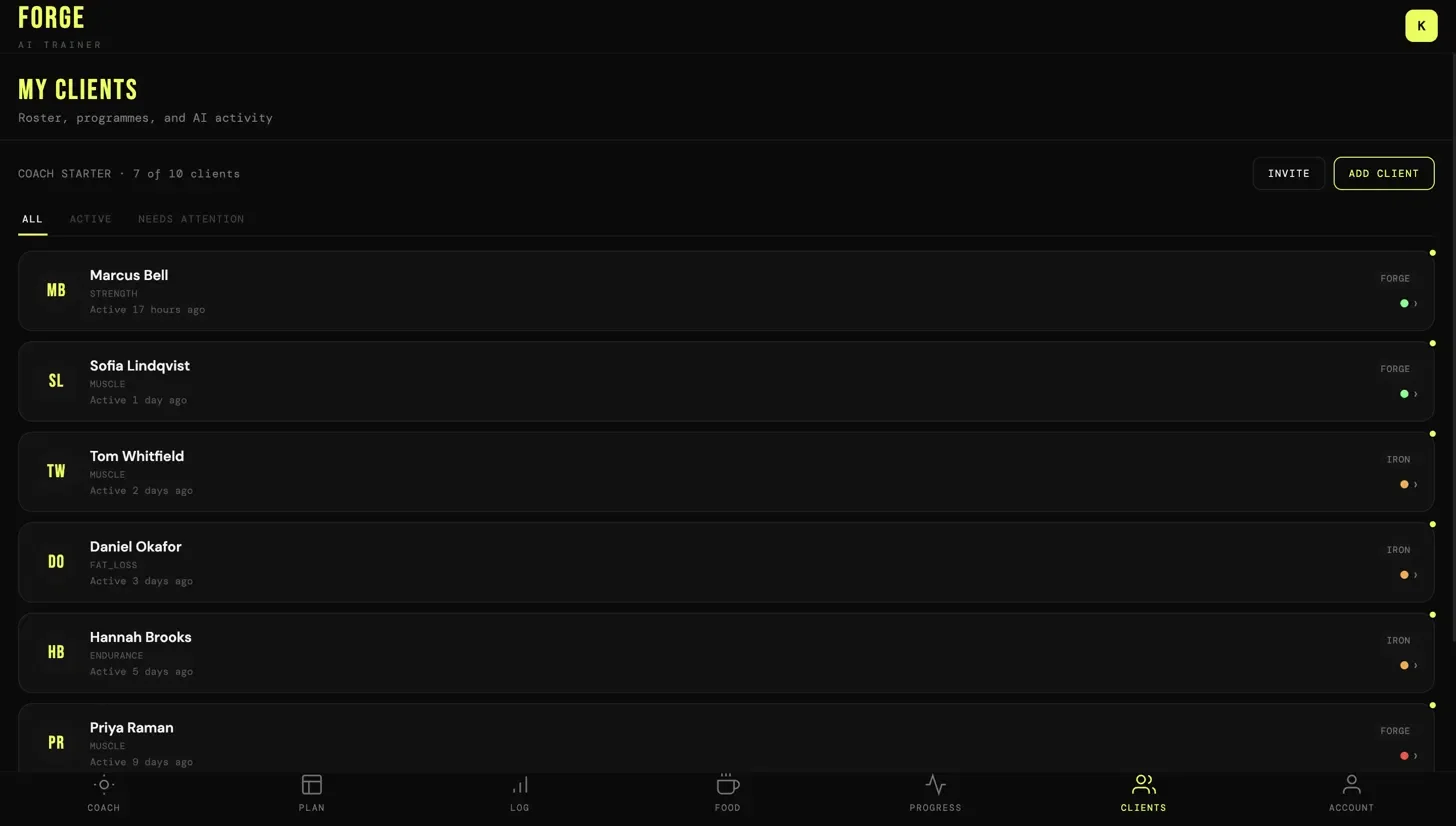
Not everyone — the ones who've stopped logging. FORGE flags a client after five quiet days and tells you. That's the behaviour that comes before a month-two cancellation, and now you see it while there's still time to act.
A written brief on every new client
The moment someone connects, their onboarding answers come back to you as a readable summary — goals, history, what they've got to train with. You walk into the first call already knowing them.
The FORGE coach client list: seven clients with their training goal, when each was last active and a status dot, filtered by All, Active and Needs attention.

Your clients get the better end of this.

This is the part most platforms treat as an afterthought, and it's the part your reputation actually runs on.

Your client's app adapts to them in real time. Squat rack taken — they tell their AI coach and the session changes around it. Training on a day that isn't scheduled — they log it and it counts. Something hurts — they say so, and the plan adjusts.

None of that generates a message for you to answer standing at your kitchen counter.

They see their progression. They get their nutrition alongside their training. They get an app that feels worth what they're paying you.

Which is the honest test of coaching software: not whether it saves you time, but whether it makes your clients more likely to stay.

Migration doesn't cost you a weekend.

The real reason you haven't switched yet isn't price. It's the thought of rebuilding your exercise library, moving historical logs, recreating templates, and talking every one of your clients through downloading another app.

Platforms know that. It's why prices keep going up and nobody leaves.

Here it doesn't work like that — not because we do the work for you, but because the work doesn't exist.
Your clients onboard themselves
You send them a link. They answer the questions the AI asks — their goals, their equipment, their injury history, their schedule. You do nothing. It arrives on your dashboard organised and ready to read.
Your programming comes across by describing it
Tell the builder your split, your progression scheme and your staples in plain language. It drafts the week into the app's structure and you edit from there. Save it as a template once and assign it to everyone who's on it. No exercise library to recreate.
And there's nothing for anyone to download
It runs in the browser and adds to their home screen like any app. No store, no install, no talking a client through anything.

You don't lose a weekend, and you don't lose a client.

What it costs.

Pro holds thirty clients for CHF 49.95 a month. Trainerize charges more than that for the same thirty.

On the annual plan it's under CHF 34 a month. Not far off half.

You'll compare us to HubFit, so here it is properly.

Their entry plan is cheaper than ours and holds more clients. It also doesn't include payments. To take money from your clients inside the platform, you need their middle tier — and that costs more than FORGE Pro.

Same story with branding and meal planning. Both start one tier up.

We don't do that. Every plan here includes everything the plan says. Payments aren't an upgrade.

And whichever tier you're on, their AI generates a programme. Then it sits there, the same as any other, until you change it by hand.

That's the difference you're paying for. Not features. Not price.

And one client covers it several times over.

At CHF 200 a month per client, one client pays for seven months of Starter. Or four months of Pro. That's before the five or six hours a week you get back — which at any sane rate for your time is worth more than the fee on its own.

You're not choosing between platforms. You're choosing between a monthly fee and the clients you can't currently take on.

Seven days free. No card required.
Showing prices in CHFchange currency
Monthly
Annual 3 months free
Starter
For coaches building their roster.
7-day free trial
Client dashboard
Programme builder
AI review controls
Start free trial
Elite
For coaches with a large client base.
7-day free trial
Everything in Pro
Start free trial
Annual is roughly three months free.
No add-ons. No fee to connect your payment processor. No module locked behind a higher tier. Nutrition isn't an upsell. The price on the plan is the price.
Start free trial — no card

What you're risking.

Seven days free. No card. Nothing to cancel if you decide against it.

Here's what isn't free.

Every month you stay where you are is a month the admin grows with the roster instead of staying put. It's another Sunday at the desk. It's the next client you don't chase, or chase and can't properly serve. And it's another year closer to being one of the coaches who leaves this profession because the admin outlasted the passion.

You didn't become a coach to do data entry on a Sunday.

The things coaches ask
before they sign up.

"My clients pay for me, not for software."
Correct, and nothing here changes that. The AI does arithmetic. You do judgement, relationship and accountability — and you approve every programme before it exists for your client. What they're paying for stays entirely yours.
"If a client finds out AI is involved, I lose them."
Most coaches handle it plainly: you use professional tools to track progression and recovery data so more of your time goes into actual coaching. That's true, and clients respond well to it — particularly when their own app got noticeably better at the same time.
"My programming is my edge."
Then keep it. The draft is a starting point, not a finished product. Coaches typically change ten to twenty percent — the judgement calls — and skip the arithmetic. Your methodology stays yours; you just stop typing it out twelve times.
"AI can't account for injuries and history."
On its own, no. That's why nothing goes out unapproved. The system flags, calculates and drafts. You catch what it can't know.
"Migration will cost me a weekend."
It won't. Your clients onboard themselves, and your programming comes across by describing it to the builder in plain language. See the switching section above.
"It's more expensive than what I'm on."
Against Trainerize, it isn't — Pro holds thirty clients for less, and considerably less on annual. Against HubFit, yes. See what it costs, above, for what you're paying the difference for.
"My clients won't download another app."
Nothing to download. It runs in the browser and adds to their home screen like any app. No store, no install.
"I've been burned by a platform before."
Fair. Seven days free with no card. If it isn't right, you've lost nothing but the time it took to look.

You know what your Sunday costs you.

Give us a week to take it off you.
Create account
Sign in
Full Name
Email
Password
Full access. Nothing locked. No commitment until your trial ends.
7 days free. No card required, cancel anytime.
7 days free · No card required · Your clients onboard themselves